
Trangia

Trangia was founded in 1925 by John E. Jonsson. His passion for technology and his interest in design were demonstrated at an early age. After opting out of a life as a farmer, John and his father-in-law started the company that for generations had led the Swedish storm kitchen industry. They started by making household containers , but as the number of vacation days increased for Swedish workers in the 1930s, demand for camping equipment grew. Trangia decided to focus on the development of cooking products especially for camping.









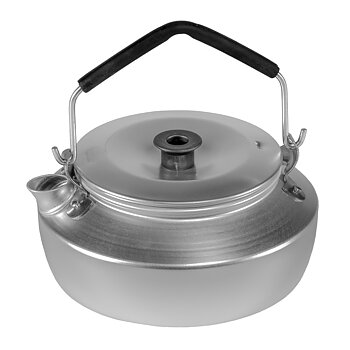


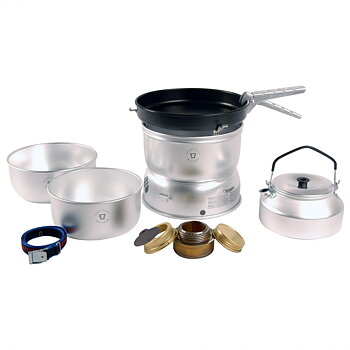
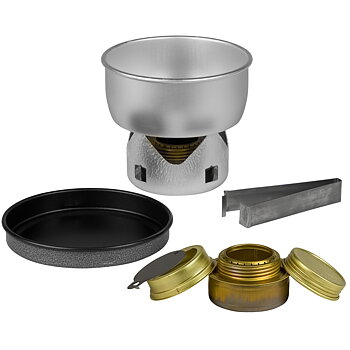
What happened to Trangia next?
In 1938, John's two sons, Olle and Erik, began working with their father and in 1951 the first prototype of the Trangia kitchenwas developed and launched. The idea was to build a compact and complete cooking system that burns liquid fuel, as this was the most efficient form of fuel and also the easiest to use. The company and its inventiveness have been passed down from generation to generation, Trangia is still entirely family-owned.
Where does the name Trangia come from
The name Trangia originates from the village of Trång. John chose to remove the circle above "a" and then add "ia" for "in aluminum". For decades, the name has been one of the strongest brands in the outdoor industry both in Sweden and internationally. Trangia represents long experience, solid competence and modern design. Trangia kitchen as a product has during its 60 years been developed and refined. Trangiaköket is still manufactured in Sweden today, in the same village where John E Jonsson started the business 90 years ago. The proximity to the mountain world today has made practical tests in harsh weather conditions a natural part of the business. Details have been modernized and the feature optimized over time. But the original, ingenious construction is still the key to today's successful Trangia kitchen.
The story of Trangia
What is a Trangia kitchen?
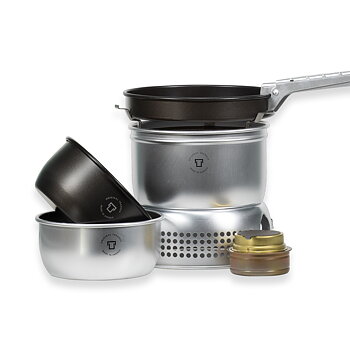
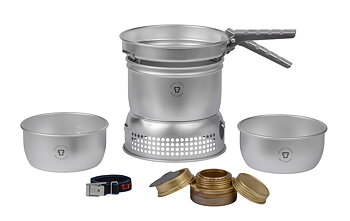
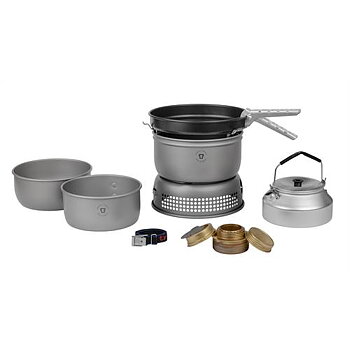
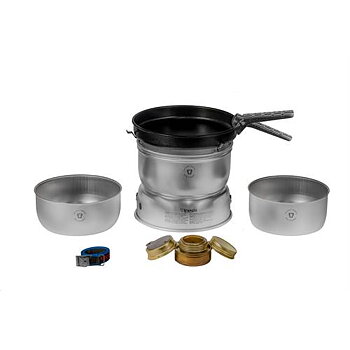
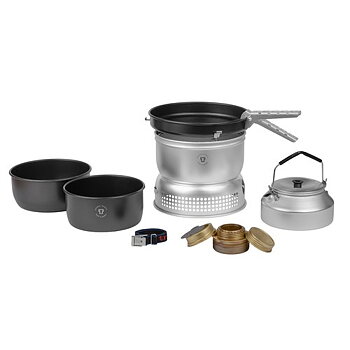
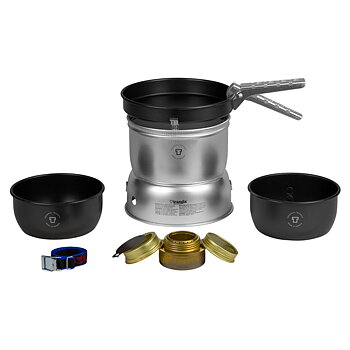
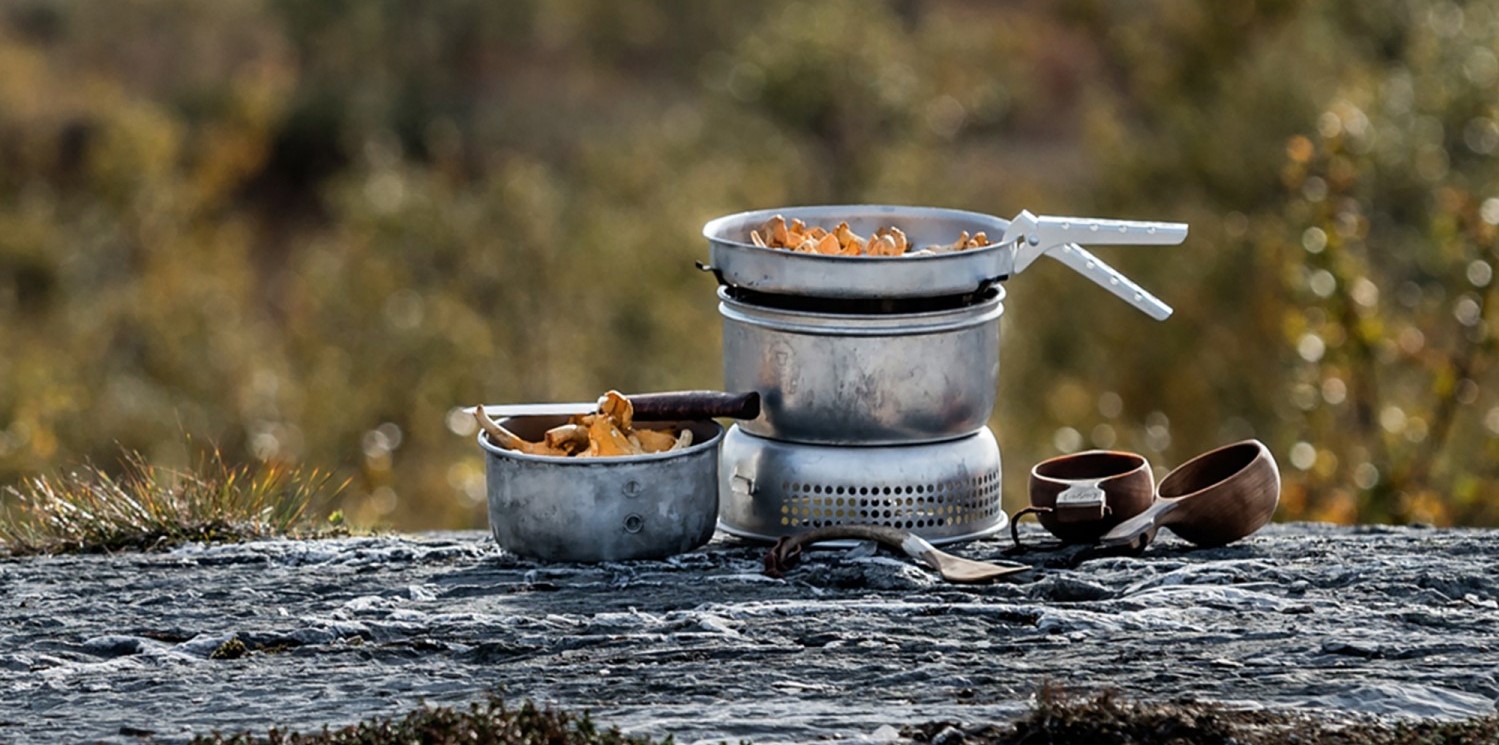
Trangia is a compact outdoor kitchen based on the aluminium case itself forming a windproof frame for cooking and frying possibilities.
Choose the right Trangia kitchen – Guide to your storm kitchen
Trangia has lots of products to choose from which is great, there really is a kitchen for everyone. But at the same time, it can get a little overwhelming when you see all the products and do not directly understand the difference. How should you think to find what suits you best?
What size Trangia kitchen should I choose?
Trangia has two sizes of its kitchens. If you are only going to cook for yourself, we recommend the smaller kitchens from the 27 series with 1 liter of saucepans, if you are going to cook for the whole family, we recommend the larger kitchens from the 25 series, with 1.5 and 1.75 liters of saucepans.
Trangia gas burner or Trangia alcohol burner in your outdoor kitchen?
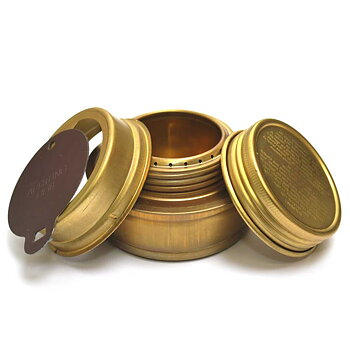
Trangia's kitchen comes either with a gas burner, spirits burner or multifuel burner. There is neither right nor wrong here, but the LPG is slightly better to handle and provides faster and higher heat so the food is faster to prepare. However, being able to burn with all combustible liquids can be an advantage. The spirit burner is slightly cheaper and can be a good start, you can always supplement with a gas burner afterwards as the kitchens themselves have the same bracket for both options. Trangia's multifuel burner provides both options in a product and may be the best made since sliced bread. A little more expensive of course but provides lots of fuellternative. As an additional option there is also Trangia Gel burner which is a cup filled with combustible gel that gives slightly higher effect than the alcohol. The advantage is also that these can be carried with no risk of leakage.
Liquid fuel recommended by Trangia itself is Tenol,T-red, Red spirit and Origonol but of course you can use everything from petrol to whisky if needed. However, think before using anything outside the recommendation.
What accessories do I need for my Trangia kitchen?
Trangia's kitchen comes in a variety of configurations as well as different content. Here the choice is decided according to the need from your outdoor life, but rather take a little too many accessories than too little if nothing else to have an extra one in case something breaks on the mountain.
How to set up your Trangia stove
What material should my Trangia outdoor kitchen have?
Trangia Ultralight /UL
Trangia's advanced base material. Aluminium is a lightweight material with good thermal conductivity. Ultralight (UL), an alloy called 5005, is 50% stronger than regular aluminum and thanks to it, the material can be made thinner and the kitchens become lighter. All parts of the kitchen are now made in UL except the coffee pan
Trangia Hardanodized / HA
By hard nodosing, the surface is made hard and scratch resistant. Protects against any wear and corrosion that may occur. It is slightly easier to clean than ultralight The weight is the same as UL because the treatment penetrates the material, so it is not a coating that can peel off. HA replaces our series in Titan as the weight became t.om lower and the surface is equally hard. Really nice are the kitchens too!
Trangia Duossal 2.0™/ D
Trangia's unique superlaminat. Duossal 2.0™ is a perfect combination of two materials in one, compressed under high pressure. Aluminium on the outside for good heat dispersion and stainless steel on the inside, which makes the vessels scratch resistant and easy to clean. The duossal vessels are durable and can be heated quickly. The thickness of the material is a total of 0.8mm. Stainless steel 0.3/ 0.5 mm. The difference with the previous version of Duossal is that there are now thicker layers of stainless steel in the containers. Here you have robust vessels for real cooking whenever you prefer to cook outdoors.
Trangia Nonstick
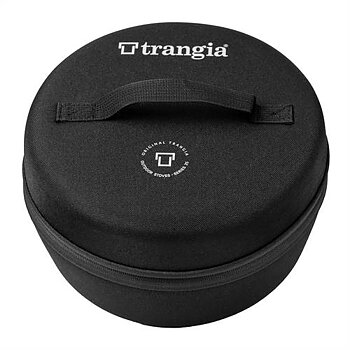
Or Teflon as it is also called, is mainly used in the frying pan but you will also find it in the vessels. It is a coating that provides a perfect surface for frying with minimal fat. It's easy to wash dishes because nothing sticks. Nonstick is a less durable material so only wood or plastic utensils should be used in these containers. Containers & frying pans should also be protected when transporting.
Care instructions for your Trangia kitchen
- Never wash a Trangia kitchen in a dishwasher. Throughout, they react badly in the dishwasher and that the surface will be rough. The food you cook will stick more easily, especially for kitchens without coating
- Only use plastic or wooden cutlery in non-stick saucepans and pans. Metal will damage the surface which will cause food to get stuck during cooking
- Be sure to clean the kitchen thoroughly before packing. Food residues that are allowed to sit over time can damage the surface of pots and pans